Minor Arcana · Swords
Knight of Swords
- speed
- assertion
- mission
- intensity
Deck position
62 of 78
Knight of Swords belongs to the Minor Arcana suit of swords, where air, thought, communication, and conflict reveal the consequences of judgment.
Browse SwordsDeck family
Swords: thought, language, and the edge of air
- thought
- truth
- conflict
- discernment
Swords concerns the force of thought and language: how a premise becomes a decision, how truth is communicated, and how conflict changes the field around it. Air is a traditional correspondence for mind and communication, not proof that detached analysis is always superior to emotion or embodied knowledge.
How to read this family
In a Swords-heavy reading, separate facts, interpretations, fears, and arguments. Identify who has information, what has been said, and which decision is actually available. Reversals can indicate distorted reasoning, suppressed speech, a truth emerging, or a conflict beginning to release its hold.
Visual symbolism
Look closely
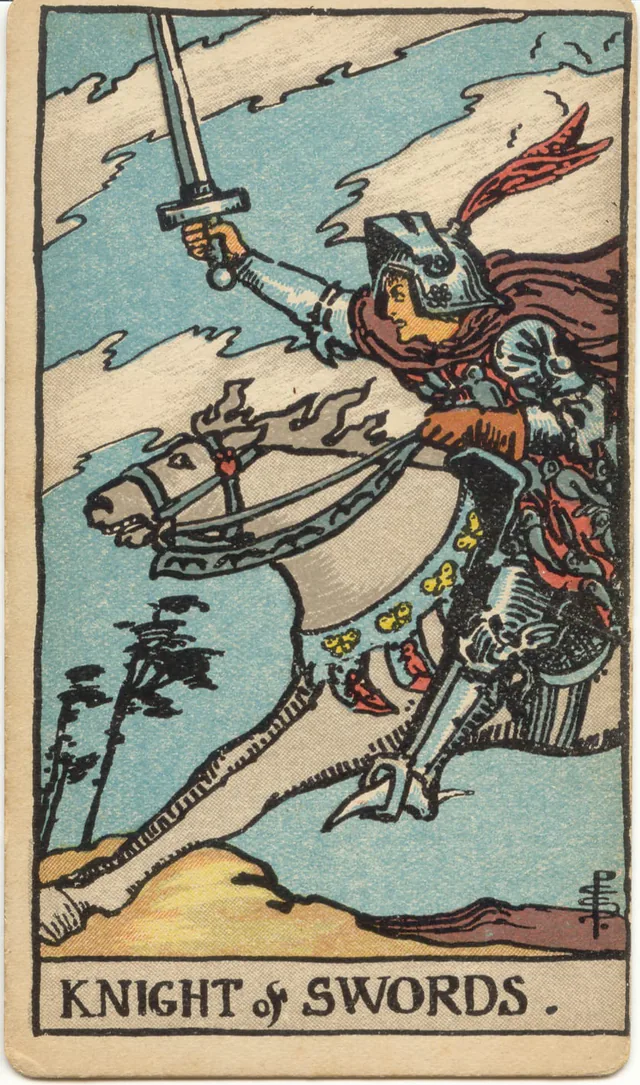
An armored knight charges with raised sword as trees and clouds bend in the wind.
The white horse drives forward through turbulent weather, giving thought the force of an attack.
Traditional core
Traditionally, Knight of Swords addresses rapid intellectual or verbal action driven by conviction and urgency.
Upright meaning
Upright, it emphasizes pursuing a clear objective boldly while keeping accuracy ahead of speed.
Reversed meaning
Reversed, it can indicate reckless argument, scattered urgency, or certainty charging beyond available facts.
Minor Arcana · Swords
Minor Arcana reading grammar
Read the suit, sequence role, and visible card evidence together; every layer comes from reviewed static content.
01 · Suit domain
Swords: thought, language, and the edge of air
- thought
- truth
- conflict
- discernment
02 · Rank or court role
Rank role · Knight
The Knight mobilizes the suit through pursuit, advocacy, quest, or reaction. It turns a value into movement, but the style of that movement—steady, impulsive, idealizing, or forceful—determines whether effort serves the objective.
03 · Card evidence
Knight of Swords
An armored knight charges with raised sword as trees and clouds bend in the wind.
How to use it in a spread
In a spread, name both the destination and the pace. The Knight asks whether movement is disciplined by feedback or whether identity has become attached to staying in motion at any cost.
Cross-check
Is the current pace serving the objective, or is motion itself being mistaken for progress?
Card-specific reflection
After checking suit, sequence role, and visible evidence, use the card's reviewed practical question to test the reading.
Continue to the card-specific reflectionRelationships
In relationships, this card highlights direct pursuit that must leave room for listening and consent.
Work & career
At work, it draws attention to a fast decision or debate needing a defined aim and error checks.
Practical reflection
Practical reflection: slow down long enough to verify the premise behind the charge.
Method & source
Method version 1.0.0 · Content version 1.0.0
A. E. Waite, The Pictorial Key to the Tarot (1910) · Pamela Colman Smith, Rider-Waite Tarot illustrations (1909) · Independently authored and editorially reviewed