Major Arcana
Death
- ending
- transition
- release
- renewal
Deck position
14 of 78
Major Arcana card thirteen concerns irreversible transition, necessary endings, and the clearing that makes renewal possible.
Browse Major ArcanaDeck family
Major Arcana: the deck's archetypal sequence
- archetype
- threshold
- transformation
- integration
Major Arcana cards are the un-suited cards of the Rider–Waite–Smith deck. Their Roman numerals and recurring figures create a visible sequence, but a reading does not have to predict a fixed destiny. The family is most useful as a vocabulary for consequential patterns, developmental turning points, and questions that reshape the frame of a situation.
How to read this family
When a Major Arcana card appears, first name the concrete image and the decision or threshold it suggests. Then ask whether the card describes the situation, the reader's stance, or a wider condition. In a multi-card reading, compare its scale with nearby Minor Arcana cards instead of treating it as automatically more important or more fated.
Visual symbolism
Look closely
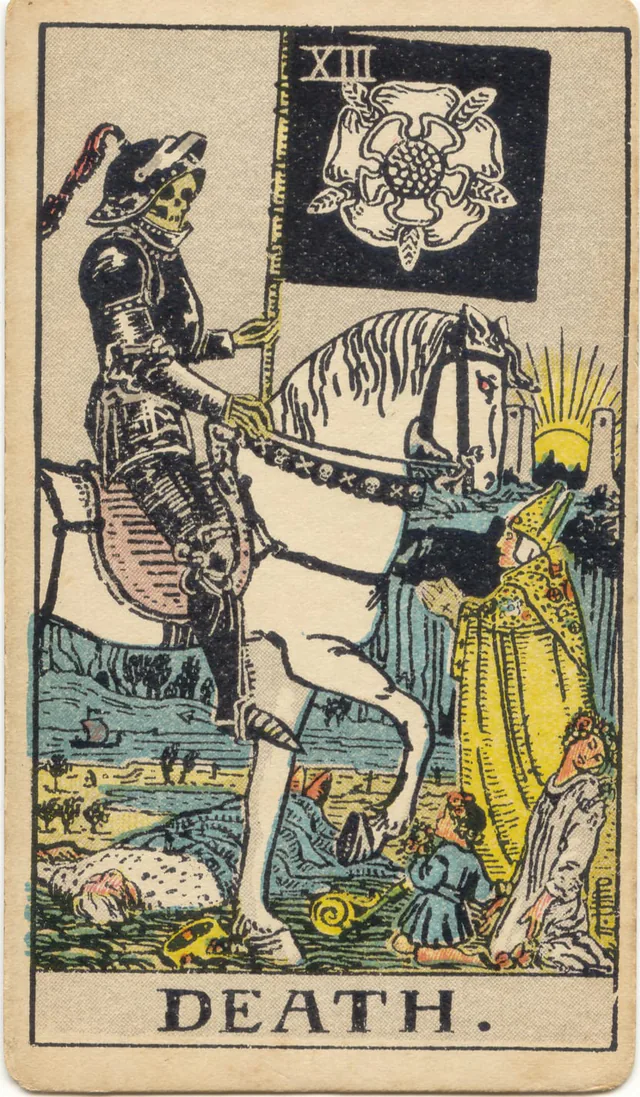
An armored skeleton rides a white horse past fallen rank, a pleading child, and a standing cleric.
A black banner bears a white rose while the sun rises between distant towers beyond the river.
Traditional core
Death signifies an ending that changes form and identity, requiring release before the next phase can take shape.
Upright meaning
A cycle has completed or must be completed; grieve what mattered, clear what is finished, and permit transformation.
Reversed meaning
An ending may be resisted, prolonged, or only partly enacted, leaving energy tied to a form that no longer works.
Major Arcana
Reading workshop
How this card organizes meaning
Death organizes irreversible transition, release, and the conditions that follow an ending. The mounted skeleton, fallen authority, rising sun, and figures meeting change prevent the card from being reduced to either catastrophe or easy renewal.
How this card works in a spread
In a spread, name what has actually ended before describing what might begin. The card can mark necessary closure and transformation, while resisting literal death claims, forced optimism, and premature replacement of grief.
Questions to test the reading
What has already changed beyond restoration, even if its emotional meaning is unfinished?
Which attachment keeps you negotiating with a condition that no longer exists?
What practical space must be cleared before a new form can responsibly emerge?
Relationships
The bond or its current pattern needs fundamental change; honesty about what has ended precedes any renewal.
Work & career
Retire an obsolete role, process, or strategy deliberately so resources can move toward the next viable form.
Practical reflection
Name what is truly over, what deserves a respectful closing, and what space its release would create.
Method & source
Method version 1.0.0 · Content version 1.0.0
A. E. Waite, The Pictorial Key to the Tarot (1910) · Pamela Colman Smith, Rider-Waite Tarot illustrations (1909) · Independently authored and editorially reviewed