Major Arcana
Temperance
- integration
- moderation
- healing
- calibration
Deck position
15 of 78
Major Arcana card fourteen depicts integration as an active practice of proportion, exchange, and patient adjustment.
Browse Major ArcanaDeck family
Major Arcana: the deck's archetypal sequence
- archetype
- threshold
- transformation
- integration
Major Arcana cards are the un-suited cards of the Rider–Waite–Smith deck. Their Roman numerals and recurring figures create a visible sequence, but a reading does not have to predict a fixed destiny. The family is most useful as a vocabulary for consequential patterns, developmental turning points, and questions that reshape the frame of a situation.
How to read this family
When a Major Arcana card appears, first name the concrete image and the decision or threshold it suggests. Then ask whether the card describes the situation, the reader's stance, or a wider condition. In a multi-card reading, compare its scale with nearby Minor Arcana cards instead of treating it as automatically more important or more fated.
Visual symbolism
Look closely
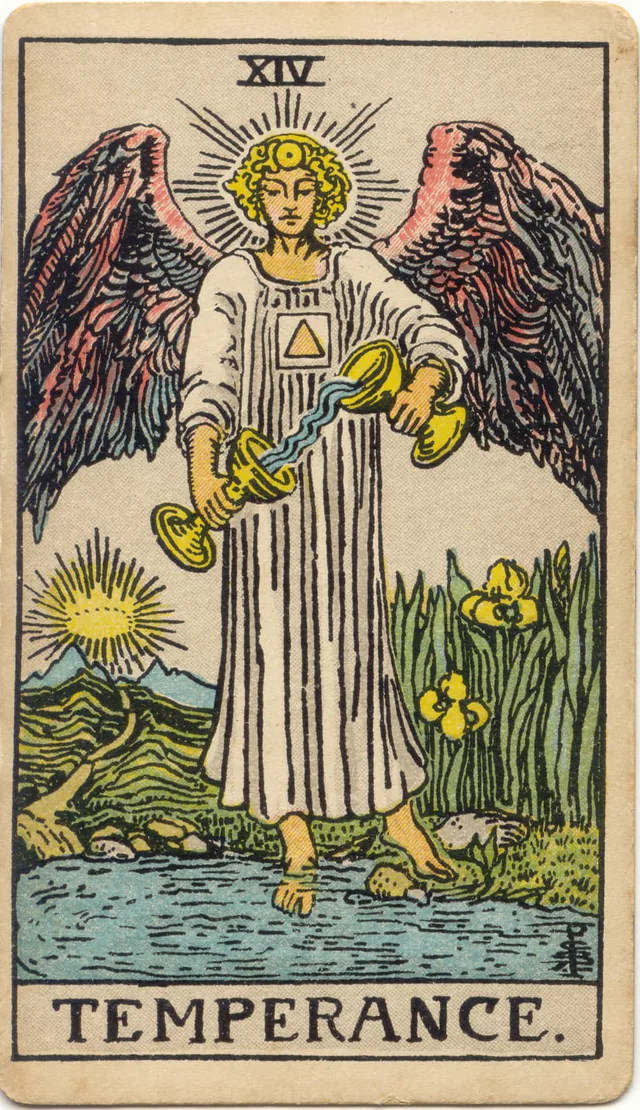
An angel pours liquid between two cups with one foot on land and one foot in water.
A path leads toward a radiant crown as irises grow nearby, joining daily balance with longer purpose.
Traditional core
Temperance represents skillful combination, moderation, and the gradual harmonizing of elements that initially differ.
Upright meaning
Adjust the mixture rather than choosing an extreme; steady experimentation can produce a more resilient whole.
Reversed meaning
Excess, poor timing, or incompatible elements may be disrupting balance; recalibration is needed before expansion.
Major Arcana
Reading workshop
How this card organizes meaning
Temperance organizes integration through measured exchange, timing, and continuous adjustment. The angel pouring between cups, one foot on land and one in water, and the distant path show balance as active calibration rather than static compromise.
How this card works in a spread
In a spread, identify what must be combined and what must remain distinct. The card can support sustainable pacing and synthesis, or expose avoidance disguised as moderation when a clear decision is required.
Questions to test the reading
Which two qualities need proportionate exchange rather than victory by either side?
What small adjustment would improve the system without destabilizing what already works?
Where is moderation serving integration, and where is it postponing a necessary choice?
Relationships
Connection improves through pacing, mutual adjustment, and room for differences to blend without disappearing.
Work & career
Coordinate teams, resources, or methods incrementally; integration deserves more attention than dramatic launch energy.
Practical reflection
Identify what is excessive, what is missing, and one small adjustment whose effect you can observe before repeating.
Method & source
Method version 1.0.0 · Content version 1.0.0
A. E. Waite, The Pictorial Key to the Tarot (1910) · Pamela Colman Smith, Rider-Waite Tarot illustrations (1909) · Independently authored and editorially reviewed