Major Arcana
Judgement
- reckoning
- awakening
- calling
- renewal
Deck position
21 of 78
Major Arcana card twenty calls for an honest reckoning that converts the past into accountable renewal.
Browse Major ArcanaDeck family
Major Arcana: the deck's archetypal sequence
- archetype
- threshold
- transformation
- integration
Major Arcana cards are the un-suited cards of the Rider–Waite–Smith deck. Their Roman numerals and recurring figures create a visible sequence, but a reading does not have to predict a fixed destiny. The family is most useful as a vocabulary for consequential patterns, developmental turning points, and questions that reshape the frame of a situation.
How to read this family
When a Major Arcana card appears, first name the concrete image and the decision or threshold it suggests. Then ask whether the card describes the situation, the reader's stance, or a wider condition. In a multi-card reading, compare its scale with nearby Minor Arcana cards instead of treating it as automatically more important or more fated.
Visual symbolism
Look closely
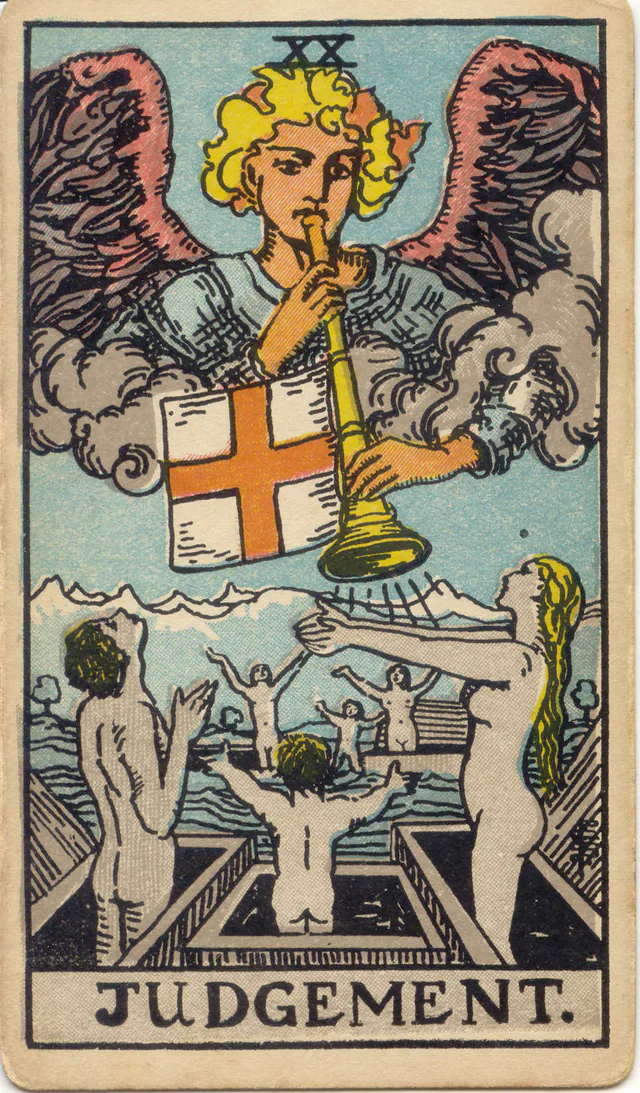
An angel sounds a trumpet above rising figures who answer from open coffins with lifted arms.
The red cross banner and distant ice peaks frame awakening as both summons and irreversible recognition.
Traditional core
Judgement represents review, moral awakening, and the decision to respond differently after understanding what the past requires.
Upright meaning
Assess the record honestly, answer the call that follows from it, and let accountability become a basis for renewal.
Reversed meaning
Self-doubt, harsh self-condemnation, or refusal to review may delay the response; discernment matters more than punishment.
Major Arcana
Reading workshop
How this card organizes meaning
Judgement organizes reckoning through response to a call that can no longer be ignored. The trumpet, rising figures, open coffins, and distant mountains ask what must be reviewed, answered, and integrated before renewal is credible.
How this card works in a spread
In a spread, distinguish accountable self-assessment from punishment. The card can mark a consequential decision and second chance, while exposing shame, denial, or the wish to be absolved without acknowledging impact.
Questions to test the reading
What past decision now needs to be reviewed with fuller evidence and adult responsibility?
Which call keeps returning because a real answer has not yet been given?
What acknowledgement or repair would make renewal more than a change of language?
Relationships
A candid reckoning can permit forgiveness or closure, but only if insight produces a changed pattern.
Work & career
A review, decision point, or vocational call asks you to integrate prior work and choose the next level consciously.
Practical reflection
Identify the lesson the evidence supports, the responsibility it creates, and the action that would demonstrate learning.
Method & source
Method version 1.0.0 · Content version 1.0.0
A. E. Waite, The Pictorial Key to the Tarot (1910) · Pamela Colman Smith, Rider-Waite Tarot illustrations (1909) · Independently authored and editorially reviewed