Major Arcana
Justice
- fairness
- accountability
- truth
- consequence
Deck position
12 of 78
Major Arcana card eleven concerns proportionate consequence, clear judgment, and responsibility grounded in evidence.
Browse Major ArcanaDeck family
Major Arcana: the deck's archetypal sequence
- archetype
- threshold
- transformation
- integration
Major Arcana cards are the un-suited cards of the Rider–Waite–Smith deck. Their Roman numerals and recurring figures create a visible sequence, but a reading does not have to predict a fixed destiny. The family is most useful as a vocabulary for consequential patterns, developmental turning points, and questions that reshape the frame of a situation.
How to read this family
When a Major Arcana card appears, first name the concrete image and the decision or threshold it suggests. Then ask whether the card describes the situation, the reader's stance, or a wider condition. In a multi-card reading, compare its scale with nearby Minor Arcana cards instead of treating it as automatically more important or more fated.
Visual symbolism
Look closely
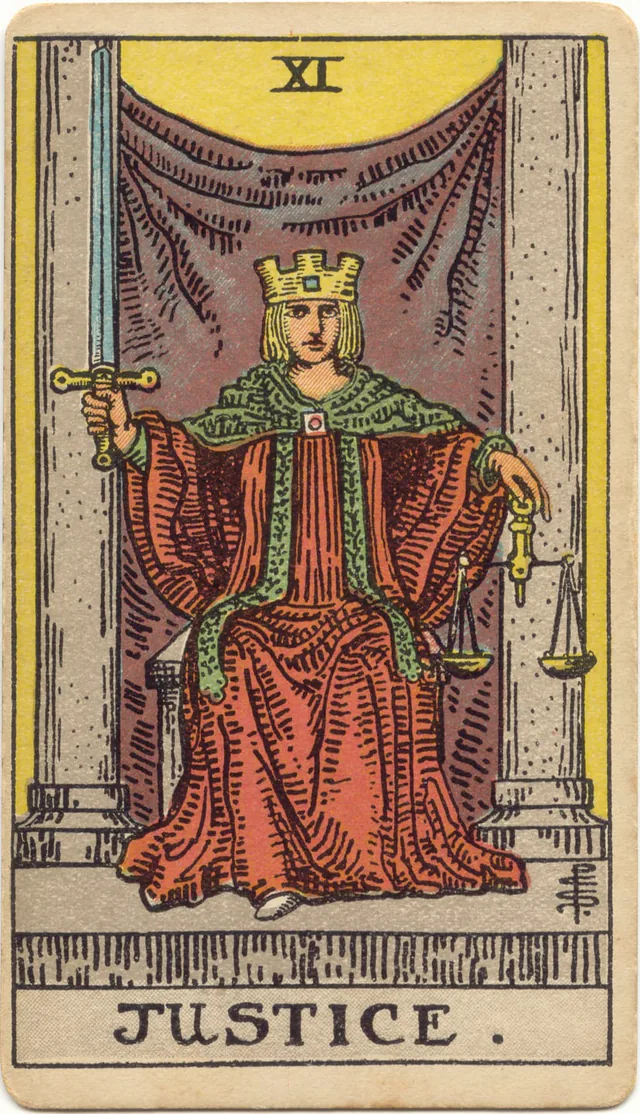
A seated figure holds upright scales in one hand and a raised double-edged sword in the other.
A square crown and symmetrical pillars emphasize reasoned structure, balance, and decisions that cut cleanly.
Traditional core
Justice signifies ethical discernment, cause and effect, and the obligation to make proportionate, evidence-based decisions.
Upright meaning
Examine facts, accept your share of consequence, and choose the response that remains defensible when viewed impartially.
Reversed meaning
Bias, avoidance, or incomplete evidence may distort judgment; review the process before insisting on a verdict.
Major Arcana
Reading workshop
How this card organizes meaning
Justice organizes judgment through evidence, proportion, and responsibility for consequences. The scales, upright sword, squared posture, and open gaze ask whether a conclusion can survive clear criteria applied consistently.
How this card works in a spread
In a spread, define the standard before deciding who is right. The card can support fair process and repair, or expose selective evidence, hidden incentives, and accountability being displaced by blame.
Questions to test the reading
Which facts are verified, and which claims are being treated as facts without support?
Would the same standard feel fair if it were applied to every person involved?
What repair is proportionate to the actual consequence rather than the intensity of the reaction?
Relationships
Reciprocity and accountability need explicit discussion, especially where an old imbalance has been normalized.
Work & career
Document decisions, apply standards consistently, and separate a fair process from the outcome you personally prefer.
Practical reflection
List the evidence for each side, name your stake in the answer, and correct one imbalance within your control.
Method & source
Method version 1.0.0 · Content version 1.0.0
A. E. Waite, The Pictorial Key to the Tarot (1910) · Pamela Colman Smith, Rider-Waite Tarot illustrations (1909) · Independently authored and editorially reviewed