Major Arcana
The Emperor
- structure
- authority
- stability
- accountability
Deck position
5 of 78
Major Arcana card four concerns durable order, legitimate authority, and the structures that make responsibility actionable.
Browse Major ArcanaDeck family
Major Arcana: the deck's archetypal sequence
- archetype
- threshold
- transformation
- integration
Major Arcana cards are the un-suited cards of the Rider–Waite–Smith deck. Their Roman numerals and recurring figures create a visible sequence, but a reading does not have to predict a fixed destiny. The family is most useful as a vocabulary for consequential patterns, developmental turning points, and questions that reshape the frame of a situation.
How to read this family
When a Major Arcana card appears, first name the concrete image and the decision or threshold it suggests. Then ask whether the card describes the situation, the reader's stance, or a wider condition. In a multi-card reading, compare its scale with nearby Minor Arcana cards instead of treating it as automatically more important or more fated.
Visual symbolism
Look closely
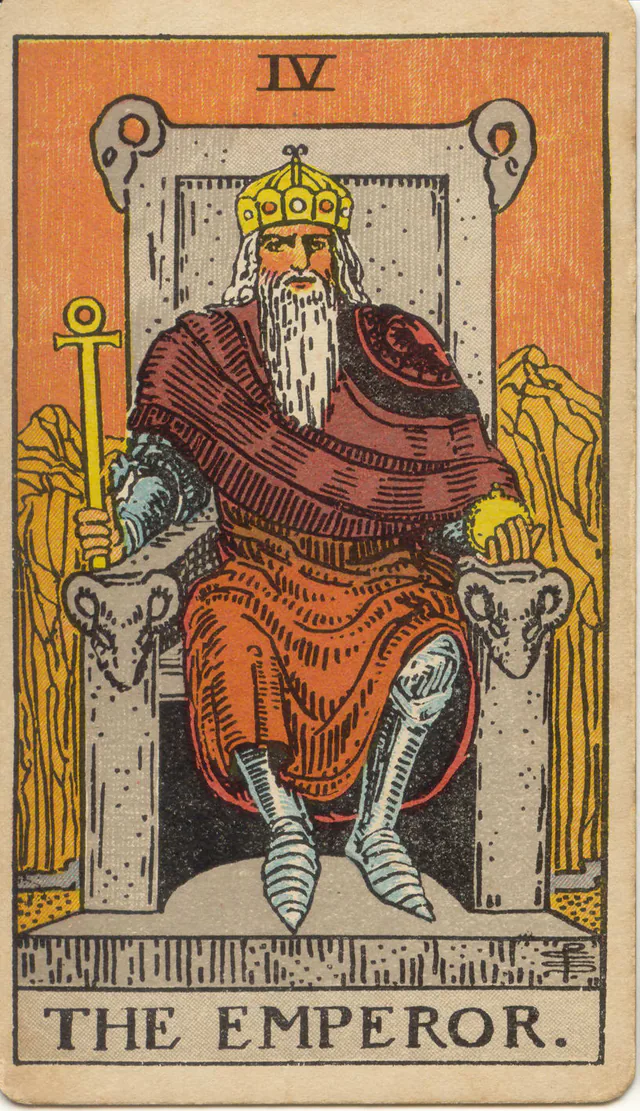
A ruler sits on a stone throne carved with ram heads, backed by stark red mountains.
Armor beneath the red robe shows that protection and readiness support the visible office of command.
Traditional core
The Emperor represents governance, boundaries, and reliable structure established through accountable use of power.
Upright meaning
Create clear roles, standards, and limits so effort can become stable rather than dependent on mood or improvisation.
Reversed meaning
Authority may harden into control or collapse into avoidance; examine whether the structure serves its stated purpose.
Major Arcana
Reading workshop
How this card organizes meaning
The Emperor organizes authority through structure, boundary, and accountable responsibility. The stone throne, armor, rams, and stark terrain ask whether order protects a real purpose or simply preserves the position of the person enforcing it.
How this card works in a spread
In a spread, examine who defines the rules, who carries the consequences, and whether decision rights are clear. The card may support durable governance or expose rigidity, avoidance, and authority without legitimacy.
Questions to test the reading
Which boundary would make responsibility clearer and the work more dependable?
Who has decision authority here, and how can that authority be held accountable?
Which rule still protects the purpose, and which now protects only habit or status?
Relationships
Security benefits from dependable agreements, but one person should not define every rule or carry every decision.
Work & career
Clarify ownership, decision rights, and operating constraints; leadership earns trust through consistency and proportion.
Practical reflection
Identify one boundary that protects the work and one rule that has outlived its usefulness, then revise deliberately.
Method & source
Method version 1.0.0 · Content version 1.0.0
A. E. Waite, The Pictorial Key to the Tarot (1910) · Pamela Colman Smith, Rider-Waite Tarot illustrations (1909) · Independently authored and editorially reviewed