Major Arcana
The Hierophant
- tradition
- teaching
- institution
- commitment
Deck position
6 of 78
Major Arcana card five examines inherited teachings, institutions, and the social transmission of meaning and practice.
Browse Major ArcanaDeck family
Major Arcana: the deck's archetypal sequence
- archetype
- threshold
- transformation
- integration
Major Arcana cards are the un-suited cards of the Rider–Waite–Smith deck. Their Roman numerals and recurring figures create a visible sequence, but a reading does not have to predict a fixed destiny. The family is most useful as a vocabulary for consequential patterns, developmental turning points, and questions that reshape the frame of a situation.
How to read this family
When a Major Arcana card appears, first name the concrete image and the decision or threshold it suggests. Then ask whether the card describes the situation, the reader's stance, or a wider condition. In a multi-card reading, compare its scale with nearby Minor Arcana cards instead of treating it as automatically more important or more fated.
Visual symbolism
Look closely
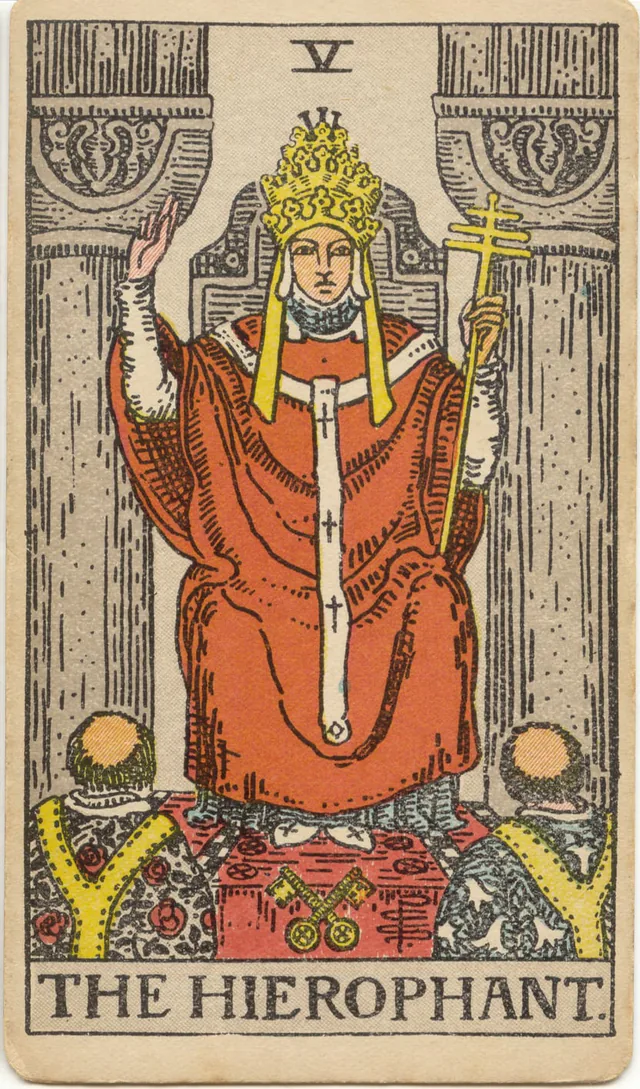
A religious teacher blesses two acolytes between pillars, placing instruction within a formal lineage.
Crossed keys lie below the triple crown and raised hand, marking access governed by established forms.
Traditional core
The Hierophant signifies tradition, mentorship, and shared frameworks that preserve knowledge through recognized practice.
Upright meaning
A tested method, teacher, or community standard can provide useful orientation and a language for commitment.
Reversed meaning
Convention may feel hollow or restrictive, inviting informed reform rather than rebellion performed without understanding.
Major Arcana
Reading workshop
How this card organizes meaning
The Hierophant organizes inherited knowledge, shared ritual, and the institutions that authorize teaching. The keys, acolytes, pillars, and formal blessing ask how a tradition preserves insight and where it may confuse repetition with truth.
How this card works in a spread
In a spread, trace the relevant rule or belief to its lineage before accepting or rejecting it. The card can point to mentorship and tested practice, or to conformity that no longer explains the needs it governs.
Questions to test the reading
Who taught this rule, and what problem was it originally designed to solve?
Which part of the tradition remains useful when separated from status and performance?
What evidence would justify keeping, adapting, or deliberately leaving this framework?
Relationships
Discuss values, commitments, and inherited expectations explicitly instead of assuming both people share the same script.
Work & career
Training, accreditation, or institutional knowledge may matter now; learn the rules before deciding which should change.
Practical reflection
Trace one belief to its source, assess what it protects, and decide whether to keep, adapt, or release it.
Method & source
Method version 1.0.0 · Content version 1.0.0
A. E. Waite, The Pictorial Key to the Tarot (1910) · Pamela Colman Smith, Rider-Waite Tarot illustrations (1909) · Independently authored and editorially reviewed