Major Arcana
The High Priestess
- intuition
- mystery
- receptivity
- discernment
Deck position
3 of 78
Major Arcana card two holds the boundary between visible knowledge and what must be approached through patience and discernment.
Browse Major ArcanaDeck family
Major Arcana: the deck's archetypal sequence
- archetype
- threshold
- transformation
- integration
Major Arcana cards are the un-suited cards of the Rider–Waite–Smith deck. Their Roman numerals and recurring figures create a visible sequence, but a reading does not have to predict a fixed destiny. The family is most useful as a vocabulary for consequential patterns, developmental turning points, and questions that reshape the frame of a situation.
How to read this family
When a Major Arcana card appears, first name the concrete image and the decision or threshold it suggests. Then ask whether the card describes the situation, the reader's stance, or a wider condition. In a multi-card reading, compare its scale with nearby Minor Arcana cards instead of treating it as automatically more important or more fated.
Visual symbolism
Look closely
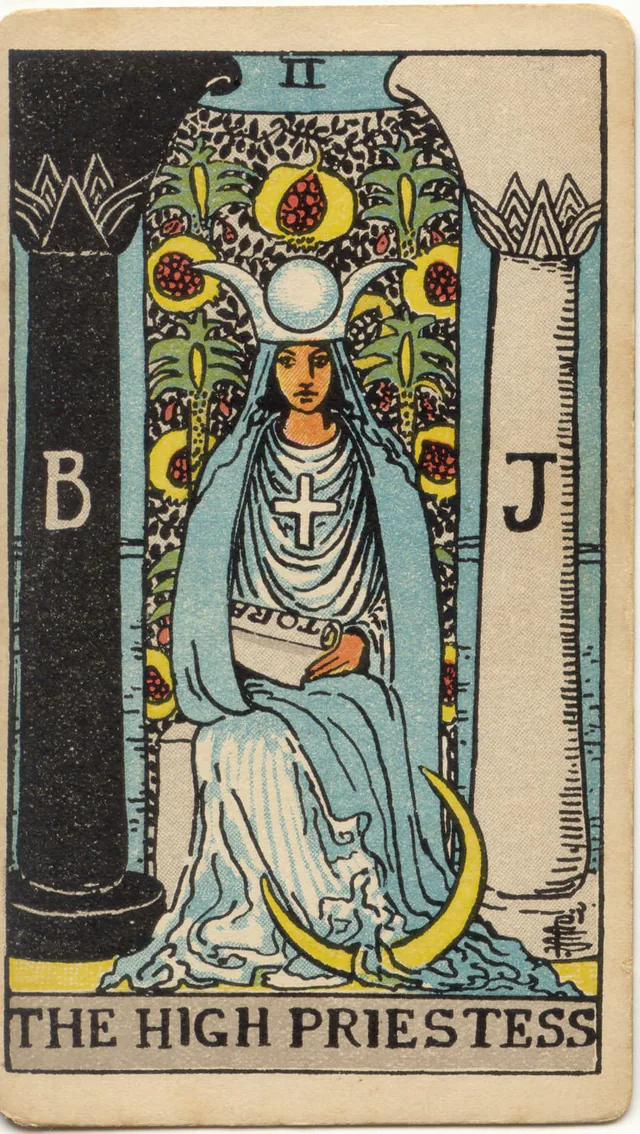
She sits between black and white pillars before a veil patterned with palms and pomegranates.
A crescent moon rests at her feet while the partly concealed scroll suggests knowledge revealed in measure.
Traditional core
The High Priestess represents inward knowing, guarded mysteries, and the wisdom of allowing incomplete information to mature.
Upright meaning
Listen before declaring a conclusion; subtle evidence and private understanding may be more useful than immediate action.
Reversed meaning
Inner signals may be obscured by secrecy, projection, or noise, calling for verification rather than forced certainty.
Major Arcana
Reading workshop
How this card organizes meaning
The High Priestess organizes the boundary between known fact, inward perception, and information not yet ready to disclose. Her veil, paired pillars, moon, and partly hidden scroll make restraint an active method rather than passive mystery.
How this card works in a spread
In a spread, distinguish a useful pause from avoidant silence. The card may ask for patient observation, protection of sensitive knowledge, or a check on projection when intuition is being treated as proof.
Questions to test the reading
What is directly known, what is sensed, and what is still only assumed?
Which information needs privacy for now, and who is legitimately entitled to it?
What future evidence would confirm or overturn the interpretation forming beneath the surface?
Relationships
Unspoken feelings deserve careful attention, but intuition should invite a respectful conversation rather than replace it.
Work & career
Research quietly, protect sensitive information, and allow a pattern to become legible before announcing a strategic move.
Practical reflection
Separate what you know, what you sense, and what you are merely assuming; decide what evidence would distinguish them.
Method & source
Method version 1.0.0 · Content version 1.0.0
A. E. Waite, The Pictorial Key to the Tarot (1910) · Pamela Colman Smith, Rider-Waite Tarot illustrations (1909) · Independently authored and editorially reviewed