Major Arcana
The Moon
- ambiguity
- instinct
- dream
- uncertainty
Deck position
19 of 78
Major Arcana card eighteen moves through ambiguity, instinct, and images that are meaningful without always being literally reliable.
Browse Major ArcanaDeck family
Major Arcana: the deck's archetypal sequence
- archetype
- threshold
- transformation
- integration
Major Arcana cards are the un-suited cards of the Rider–Waite–Smith deck. Their Roman numerals and recurring figures create a visible sequence, but a reading does not have to predict a fixed destiny. The family is most useful as a vocabulary for consequential patterns, developmental turning points, and questions that reshape the frame of a situation.
How to read this family
When a Major Arcana card appears, first name the concrete image and the decision or threshold it suggests. Then ask whether the card describes the situation, the reader's stance, or a wider condition. In a multi-card reading, compare its scale with nearby Minor Arcana cards instead of treating it as automatically more important or more fated.
Visual symbolism
Look closely
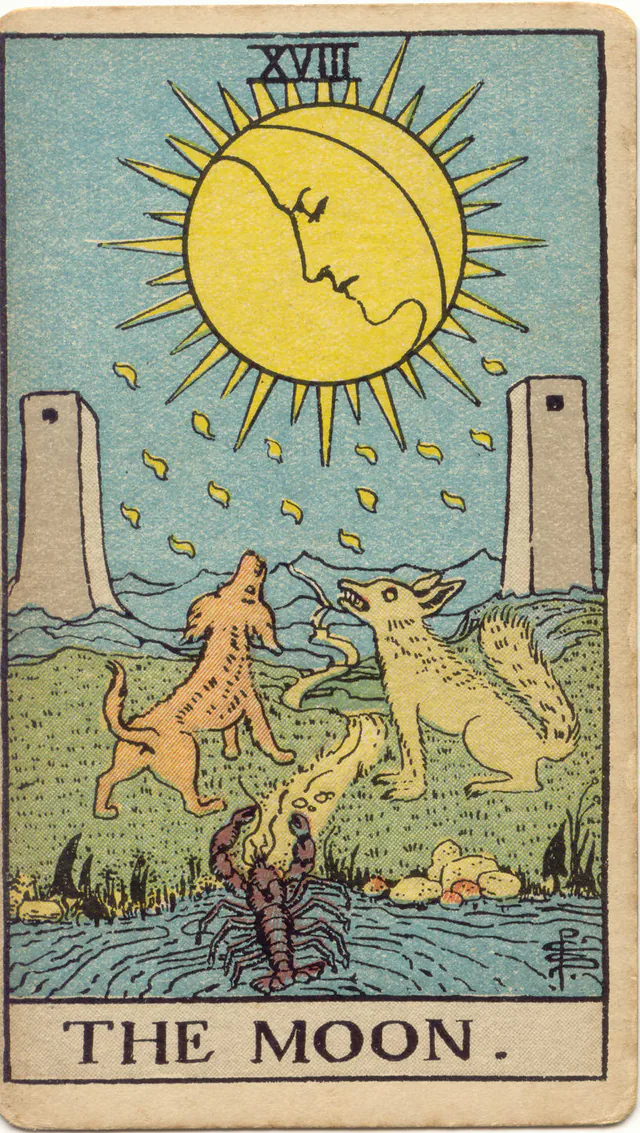
A dog and wolf howl between two towers while a crayfish rises from dark water onto a winding path.
The moon sheds alternating drops of light, creating a landscape where familiar forms remain difficult to judge.
Traditional core
The Moon represents uncertainty, imagination, and instinctive material that requires navigation without premature certainty.
Upright meaning
Proceed slowly through incomplete information, attending to intuition while checking where fear or fantasy alters perception.
Reversed meaning
Confusion may begin to clear, or anxiety may intensify through avoidance; test impressions against observable evidence.
Major Arcana
Reading workshop
How this card organizes meaning
The Moon organizes uncertainty through imagination, instinct, partial visibility, and distorted scale. The path, towers, animals, water, and descending light ask how fear and intuition behave when evidence is incomplete.
How this card works in a spread
In a spread, slow interpretation down and separate signal from projection. The card can validate ambiguity and dream material, but it also requires verification where anxiety, secrecy, or misleading appearances affect decisions.
Questions to test the reading
Which part of the situation is genuinely unknown rather than merely uncomfortable?
What feeling may be magnifying a weak signal into a complete story?
Which fact, conversation, or timed observation would make the path more legible?
Relationships
Mixed signals and projection need patient clarification; neither suspicion nor idealization should substitute for dialogue.
Work & career
Hidden factors or uncertain timing argue for verification, scenario planning, and smaller reversible commitments.
Practical reflection
Separate the observed fact, the felt signal, and the story built around them; investigate the widest gap.
Method & source
Method version 1.0.0 · Content version 1.0.0
A. E. Waite, The Pictorial Key to the Tarot (1910) · Pamela Colman Smith, Rider-Waite Tarot illustrations (1909) · Independently authored and editorially reviewed