Minor Arcana · Swords
Five of Swords
- conflict
- defeat
- ego
- aftermath
Deck position
55 of 78
Five of Swords belongs to the Minor Arcana suit of swords, where air, thought, communication, and conflict reveal the consequences of judgment.
Browse SwordsDeck family
Swords: thought, language, and the edge of air
- thought
- truth
- conflict
- discernment
Swords concerns the force of thought and language: how a premise becomes a decision, how truth is communicated, and how conflict changes the field around it. Air is a traditional correspondence for mind and communication, not proof that detached analysis is always superior to emotion or embodied knowledge.
How to read this family
In a Swords-heavy reading, separate facts, interpretations, fears, and arguments. Identify who has information, what has been said, and which decision is actually available. Reversals can indicate distorted reasoning, suppressed speech, a truth emerging, or a conflict beginning to release its hold.
Visual symbolism
Look closely
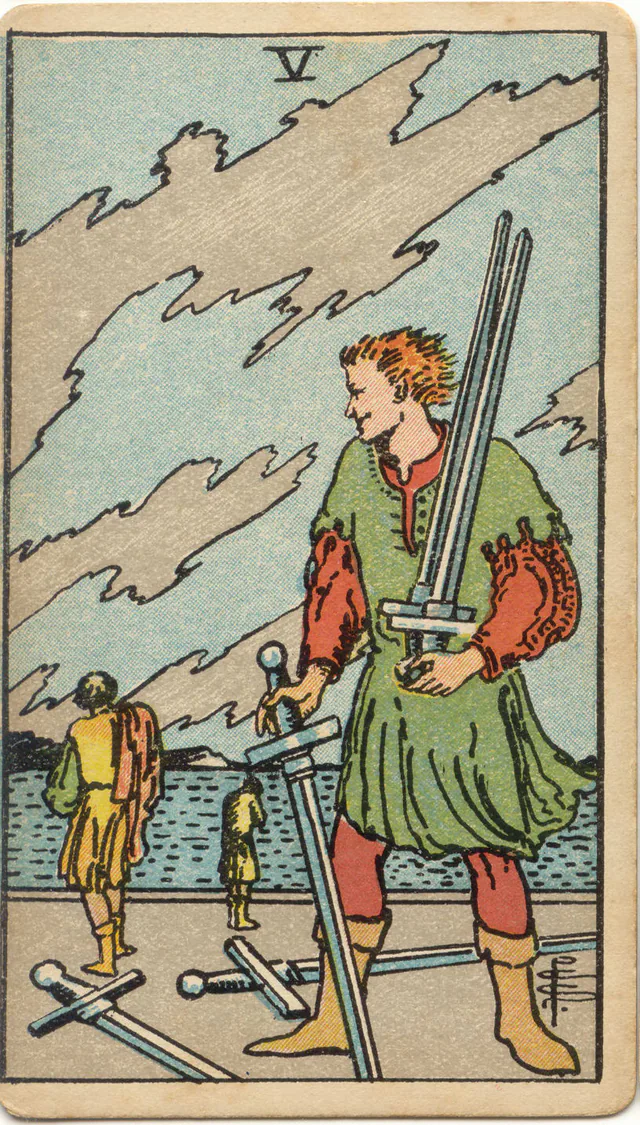
A smirking figure gathers swords while two others walk toward a gray sea in defeat.
Jagged clouds echo the uneven blades, emphasizing a victory that has damaged the wider field.
Traditional core
Traditionally, Five of Swords addresses conflict where winning, humiliation, and aftermath matter more than the original issue.
Upright meaning
Upright, it emphasizes assessing whether victory is worth the relational or strategic cost.
Reversed meaning
Reversed, it can indicate remorse, attempted reconciliation, or resentment continuing after open conflict ends.
Minor Arcana · Swords
Minor Arcana reading grammar
Read the suit, sequence role, and visible card evidence together; every layer comes from reviewed static content.
01 · Suit domain
Swords: thought, language, and the edge of air
- thought
- truth
- conflict
- discernment
02 · Rank or court role
Rank role · Five
The Five introduces stress, loss, conflict, or disruption into an established pattern. Its tension exposes what the prior structure could not hold and makes the cost, competition, scarcity, or disagreement in the suit's domain harder to ignore.
03 · Card evidence
Five of Swords
A smirking figure gathers swords while two others walk toward a gray sea in defeat.
How to use it in a spread
In a spread, name the actual disruption before treating discomfort as failure. Ask what has been lost, contested, or destabilized, and what information the disturbance reveals about the system around it.
Cross-check
What is the conflict or loss showing that was easier to overlook while the pattern still felt stable?
Card-specific reflection
After checking suit, sequence role, and visible evidence, use the card's reviewed practical question to test the reading.
Continue to the card-specific reflectionRelationships
In relationships, this card highlights arguments that need repair rules and an end to scorekeeping.
Work & career
At work, it draws attention to political wins that may weaken trust, retention, or future cooperation.
Practical reflection
Practical reflection: calculate the full cost of being right in this way.
Method & source
Method version 1.0.0 · Content version 1.0.0
A. E. Waite, The Pictorial Key to the Tarot (1910) · Pamela Colman Smith, Rider-Waite Tarot illustrations (1909) · Independently authored and editorially reviewed