Minor Arcana · Wands
Five of Wands
- friction
- competition
- testing
- difference
Deck position
27 of 78
Five of Wands belongs to the Minor Arcana suit of wands, where fire, initiative, ambition, and creative will are tested through action.
Browse WandsDeck family
Wands: initiative, appetite, and directed fire
- initiative
- desire
- creativity
- direction
Wands concerns what wants to move: desire, creative force, enterprise, courage, competition, and the energy required to begin. Fire is a traditional correspondence and a reading language, not a measurable personality substance. The suit asks where momentum is useful, where it scatters, and what purpose can contain it.
How to read this family
In a Wands-heavy reading, identify the desired movement before deciding that more action is automatically better. Compare inspiration with capacity, urgency with timing, and visible confidence with the work required after excitement fades. Reversed cards can show blocked fire, misdirected force, depletion, or a need to revise the container.
Visual symbolism
Look closely
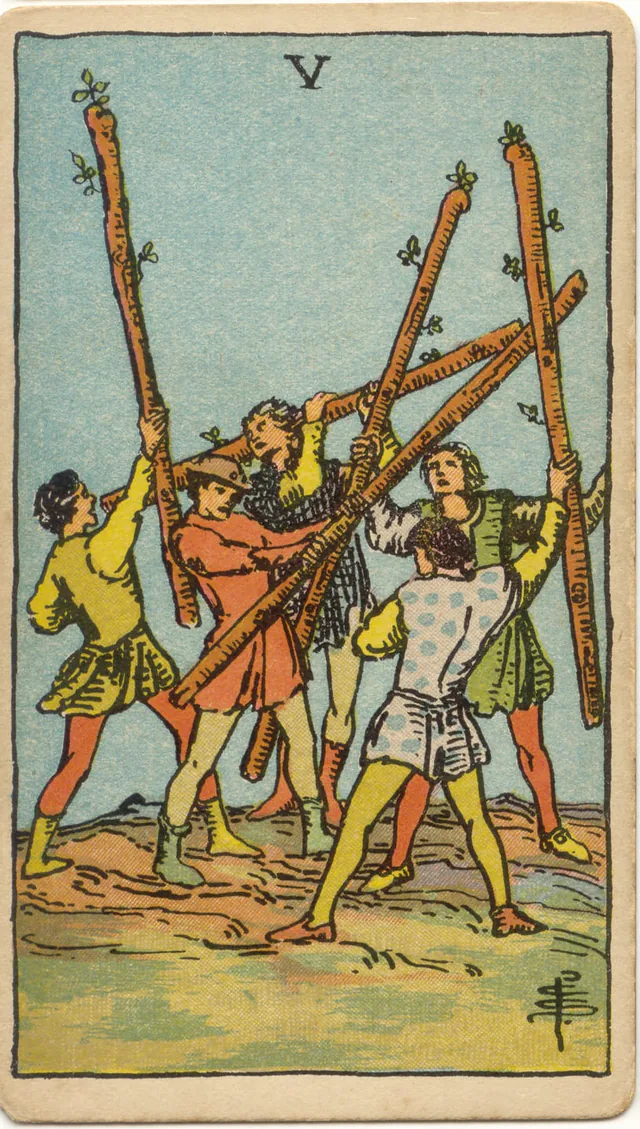
Five youths raise crossing wands in a scene that resembles both contest and disorderly practice.
No clear victor or grave injury appears, making the conflict energetic, plural, and potentially instructive.
Traditional core
Traditionally, Five of Wands addresses friction among competing aims where skill, position, and group coordination are being tested.
Upright meaning
Upright, it emphasizes using manageable conflict to expose differences, sharpen capability, and improve collective rules.
Reversed meaning
Reversed, it can indicate suppressed disagreement, exhausting contention, or a move toward resolution after needless noise.
Minor Arcana · Wands
Minor Arcana reading grammar
Read the suit, sequence role, and visible card evidence together; every layer comes from reviewed static content.
01 · Suit domain
Wands: initiative, appetite, and directed fire
- initiative
- desire
- creativity
- direction
02 · Rank or court role
Rank role · Five
The Five introduces stress, loss, conflict, or disruption into an established pattern. Its tension exposes what the prior structure could not hold and makes the cost, competition, scarcity, or disagreement in the suit's domain harder to ignore.
03 · Card evidence
Five of Wands
Five youths raise crossing wands in a scene that resembles both contest and disorderly practice.
How to use it in a spread
In a spread, name the actual disruption before treating discomfort as failure. Ask what has been lost, contested, or destabilized, and what information the disturbance reveals about the system around it.
Cross-check
What is the conflict or loss showing that was easier to overlook while the pattern still felt stable?
Card-specific reflection
After checking suit, sequence role, and visible evidence, use the card's reviewed practical question to test the reading.
Continue to the card-specific reflectionRelationships
In relationships, this card highlights differences that need fair engagement without turning every preference into a battle.
Work & career
At work, it draws attention to competing priorities or ideas that require facilitation, criteria, and a shared objective.
Practical reflection
Practical reflection: identify the real point of disagreement and establish one rule for productive contest.
Method & source
Method version 1.0.0 · Content version 1.0.0
A. E. Waite, The Pictorial Key to the Tarot (1910) · Pamela Colman Smith, Rider-Waite Tarot illustrations (1909) · Independently authored and editorially reviewed